
Thermal Surveys
At Build IR, we provide professional thermal surveys and thermal imaging surveys for commercial, industrial, construction and residential projects across the UK.
With one of the only UK PCN Category 3 Civil Thermographers surveying in the field, we can work with you on any project, regardless of size or scope.
Whether you need a commercial thermal survey, a building envelope thermographic inspection, a heat loss survey or a targeted diagnostic investigation, we can provide clear thermal evidence and practical reporting you can act on.
Professional surveys carried out by experienced thermography specialists.
Why Do Clients Choose Thermal Surveys?
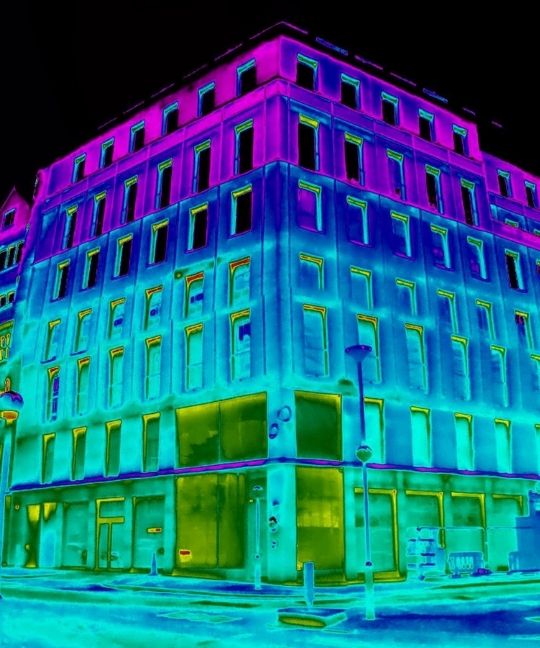
A thermal survey for any building type, whether residential or commercial, can provide a large number of benefits. By utilising a state-of-the-art thermal imaging camera, it is possible to detect and identify a number of anomalies within your building which are normally not visible to the naked eye e.g. heat loss, air leakage, defective insulation and cold bridging.
Thermographic measurements taken by the thermal imaging camera will record temperature variations of the building’s envelope, with the resulting images helping our engineers to determine where remedial works may be required. They can also operate as a quality control tool, ensuring that insulation has been installed correctly.
It’s not uncommon for buildings to suffer from heat loss, water infiltration, cold bridging, or inadequate insulation. Recognising these anomalies before it is too late will assist you in maintaining your property, saving money, and reducing your carbon impact, among other benefits. When conducting a thermal survey on your building, we can identify any areas where energy loss is taking place.
The use of thermal imaging can help to decrease the need for potentially expensive and invasive construction work on a building. To highlight the effects of leakage on insulation, insulation.org found that when compared to dry insulation, wet insulation can result in a tenfold increase in heat loss.
Why Thermal Surveys Matter
Buildings do not always perform as expected. A building may appear complete, compliant or visually sound while still suffering from hidden performance issues. These can include heat loss, thermal bridging, air leakage, defective insulation, water ingress or localised comfort problems.
A professional thermal survey can help identify these issues earlier, reducing the need for unnecessary invasive investigation and supporting more informed decisions about remedial work, maintenance, project handover or further testing.
Thermal surveys can be useful for:
- identifying unnecessary heat loss
- investigating cold spots and comfort complaints
- checking insulation continuity
- locating potential air leakage paths
- identifying thermal bridging
- supporting building envelope investigations
- assisting with roof and moisture investigations
- supporting planned maintenance and asset management
- providing evidence for construction teams, consultants and property owners.
PROFESSIONAL THERMOGRAPHY IN ACTION
What Can a Thermal Survey Identify?
Heat Loss
Thermal surveys can highlight areas where heat is escaping from a building. This may be associated with poor insulation, gaps in the building fabric, defective detailing or uncontrolled air movement.
Thermal Bridging
Thermal bridging occurs where heat transfers more readily through part of a building element, often at junctions, structural elements or poorly detailed interfaces. This can contribute to cold internal surfaces and localised heat loss.
Insulation Defects
Thermal imaging can help identify missing, displaced, compressed or poorly installed insulation. These issues can reduce building performance and contribute to cold areas, higher energy demand and occupant discomfort.
Moisture-Related Anomalies
Thermal imaging can assist further investigation of suspected moisture issues by highlighting thermal patterns which may be associated with damp materials, water ingress or roof envelope defects.
Air Leakage Paths
Air leakage can occur around junctions, penetrations, window and door interfaces, roof voids, service routes and other gaps in the building fabric. Thermal imaging can help reveal patterns associated with uncontrolled air movement.
Building Performance Issues
A thermal survey can help explain why a building feels cold, draughty or inefficient, even where there is no obvious visible defect. These building performance gaps can be significant and show discrepancies with construction sign-offs.
Our Thermal Survey Process
Initial Enquiry
We discuss the building, location, project requirements, known issues and the reason for the thermal survey.
Survey Planning
We consider the best survey method, access requirements, timing, environmental conditions and reporting objectives.
On-Site Thermal Imaging
Thermal data is captured using professional infrared equipment by experienced thermographers.
Review and Interpretation
The thermal images are reviewed alongside site context, building knowledge and observed conditions.
Report Delivery
You receive a clear thermal survey report outlining relevant findings, images, observations and practical next steps.
When Is the Best Time to Carry Out a Thermal Survey?
The best time for a building thermal survey depends on the survey type and the conditions required.
For heat loss, building envelope and insulation-related surveys, a clear temperature difference between inside and outside is usually important. Weather conditions, wind, rain, solar gain and heating operation can all influence the quality of the results.
Electrical thermal surveys are different. These are often carried out while systems are operating under normal load, allowing abnormal heat patterns to be identified.
Build IR can advise on suitable timing once the building type, survey purpose and site conditions are understood.
Thermographic Inspections
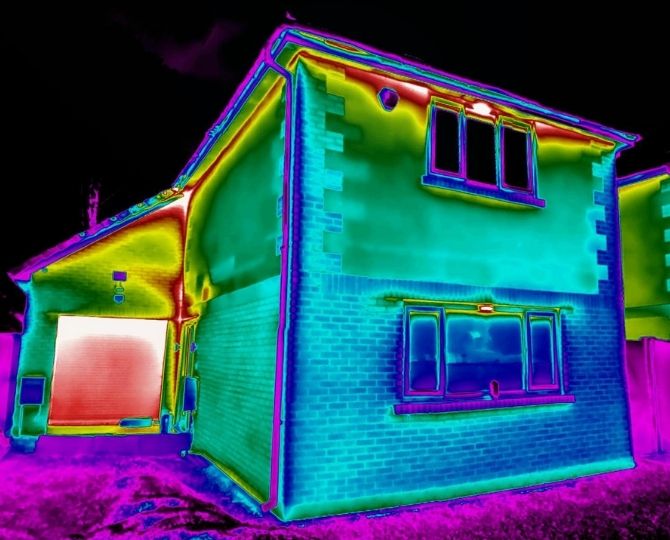
A thermographic inspection can be carried out either internally, externally or using a combination of both methods. Depending on the weather conditions and access, our thermal surveyor will determine which strategy will produce the best results.
Interior scans can often highlight issues that are not uncovered on an external only survey, such as with thermal bypass and “open loop” convection (Mass transport of air through gaps in the structure).
It is possible that an anomaly recorded in one part of an internal wall is due to an issue occurring in another area of the outside wall, and vice versa. Additionally, during windy conditions, it is more difficult to detect temperature variations on the outside surface of the structure. As a result of this challenge, interior thermal surveys are often more accurate than exterior thermal surveys because of the reduced effect of atmospheric conditions.
We undertake a comprehensive approach in our thermal imaging inspections. If necessary, we can use drone or UAV’s (Unmanned Aerial Vehicles) thermal cameras to inspect harder-to-reach areas of the building. Our evaluation can include any elevations, roofs, or windows – with any and all abnormalities found highlighted
Afterwards, the thermal images (RJpegs) are processed and evaluated by our Thermographers to enable the detection of any vulnerabilities in your building’s structure. The images are then included in a report in a way which makes them understandable to the “untrained” eye.
Through a thermographic inspection, you can receive a unique look at your building that you have never seen before, highlighting areas which are not visible to the naked eye.
BUILT ON TRUST. DRIVEN BY RESULTS.
Why We are Chosen by Clients around the UK

PCN Cat. 3 Civil Thermographer
Build IR distinguishes itself from many other surveyors, as it is one of the few specialist thermography companies in the entirety of the UK to have a PCN Category 3 Civil Thermographer actively carrying out surveys in the field.

Fully Insured Thermographer
Build IR is fully insured to carry out professional thermographic surveys across commercial, industrial and residential projects, giving clients confidence and peace of mind throughout the survey process.

UKTA Member
We are proud members of the United Kingdom Thermography Association (UKTA), supporting professional standards, technical knowledge and best practice across the thermography industry within the country.
Qualified Thermographic Surveys
Carried out by a minimum Category 2 PCN Qualified Thermographer.
Planned and overseen by a Cat 3 PCN Qualified Thermographer

Extensive Experience
With over 20 years of construction experience and 15 years specialising in thermography, we combine imaging expertise with a practical understanding of buildings, materials and performance.

Compliant To UK Regulations
BS EN 13187:1999: Thermal performance of buildings – qualitative detection of thermal irregularities in building envelopes – infra-red method.
BRE Report 176: A Practical Guide to Infra-Red Thermography for Building Surveys.
Will a Thermal Survey Detect Missing Cavity Wall Insulation?
This non-invasive method of checking your home for heat loss issues (heat loss survey) such as cold spots and issues with cavity wall insulation can be used to identify a wide range of issues with your home’s energy efficiency rate.
It is possible for our certified and experienced thermographers to detect regions of inadequate insulation within the cavity of your brick walls, around windows, and above the ceilings of your loft space.
An effective heat loss survey will clearly identify places where insulation is lacking, as well as the extent to which these anomalies have an impact on the temperature in your room. In addition to identifying areas that need to be addressed, we may also assess the potential impact of these concerns on your living environment.
We are also able to provide inspections for concerns such as water leak detection, which allows us to locate areas of water penetration into your property using Thermography technology.
Thermal Heat Loss Survey: A Definition
This is a thermographic inspection of your building’s structure utilising an infrared camera to determine the efficiency of your building envelope’s heat retention abilities. Following the inspection we will suggest areas where improvements can be made.
Our qualified thermographers deploy thermal cameras and thermal imagining inspection software to highlight any potential areas of concern. When addressed properly, these issues can help improve heating efficiency and reduce unnecessary carbon emissions.
Thermal heat loss surveys identify:
- Poorly installed or missing insulation.
- Air leakage paths – these can create cold areas in a property and even lead to damp.
- Sub-floor heating issues.
Who can Benefit from Receiving a Thermographic Inspection And Survey?
At Build IR we advocate a thermal survey to anyone who pays for energy and thinks they are paying more than they should.
Today people are more aware than ever that the earth has a finite number of resources and they shouldn’t be wasted needlessly – by conducting a thermal survey it’s possible to identify issues which are squandering these resources.
Thermal imaging cameras have already helped save millions by highlighting and helping surveyors address energy wastage across the globe.
Build IR are able to cover a larger area of your property portfolio in a smaller timeframe.
Reduced heat loss, as well as the ability to identify properties that have concerns, allows you to be proactive rather than reactive in your approach.
A breakdown of property owners who can benefit from thermal imaging surveys include:
Commercial Developers
By carrying out a thermographic inspection as the project completes you can confirm the buildings thermal performance and identify any areas of defect prior to handing the building over to the client.
Residential Homeowners
An assessment of your home may help you quickly and easily discover areas which are costing you money – this can be through gas or electricity costs which are compensating for lost heat. Repairing any problems which have been detected can save hundreds of pounds each year. Other concerns such as water leak issues may develop into greater problems if not addressed and fixed at the earliest possible time.
Facility Managers
Whether you manage a large or small property, heat loss can be a significant financial burden for you and your tenants. Tenants will be happier as a result of your assistance in identifying and repairing problems in their building, and your carbon footprint will be reduced.
Housing Associations and Boards
A comprehensive Drone Site Survey (DSS) can help pinpoint areas of heat loss within housing stock, no matter how many.
750+ BREEAM Surveys
Extensive experience across buildings of different sizes, uses and construction types.

Specialist Thermography
Surveys completed by qualified thermographers with Category 3 planning and oversight.

Advanced Equipment
High-specification thermal imaging technology capable of revealing subtle thermal anomalies.

Actionable Reporting
Clear evidence and practical findings for contractors, consultants, facilities teams and asset owners.
U-Values: What & Why are they Important when Conducting Surveys?
Heat transfer through a structure, whether it is made from a single material or a composite build-up, is measured as the rate of heat transfer divided by the difference in temperature across that structure.
This is known as the U-value. The units of measurement are Watts per square metre per kelvin (W/m²K). In simple terms, the lower the U-value, the better that element should perform thermally, as less heat is able to pass through it.
The U-value of a structure decreases in direct proportion to how well it is insulated. However, the calculated U-value of a wall, roof, floor, window or door is only part of the picture.
The quality of workmanship, continuity of insulation, junction detailing and installation standards can all have a significant impact on the actual thermal performance achieved on site. A building may be designed to meet a specific thermal standard, but poor installation or hidden defects can create a gap between designed performance and real-world performance.
Because of holes, gaps, compression, missing insulation and cold bridges in poorly installed insulation, the thermal transmittance can be significantly higher than anticipated.
Conduction, convection and radiation are all factors that contribute to thermal transmittance and should be considered when assessing a building’s performance. Thermal imaging surveys are valuable because they can help identify areas where the building fabric may not be performing as expected, highlighting patterns of heat loss, thermal bridging, air movement and other anomalies that may require further investigation.
Thermal Surveys FAQs
What is a thermal survey?
A thermal survey is a non-invasive inspection that uses infrared thermal imaging to detect temperature differences across a building, roof, electrical system or component.
These patterns can help identify heat loss, insulation defects, air leakage, thermal bridging, moisture-related anomalies and other building performance issues.
What is the difference between a thermal survey and a thermal imaging survey?
The terms are often used interchangeably. A thermal imaging survey, or thermographic survey, uses an infrared camera to capture thermal data, while a broader thermal survey should also include planning, interpretation, and reporting of the findings.
What can a thermal survey detect?
A thermal survey can help identify heat loss, missing insulation, defective insulation, cold bridging, air leakage paths, moisture-related anomalies, roof issues and areas where further investigation may be required.
Can thermal surveys find heat loss?
Yes. Heat loss is one of the most common reasons for carrying out a building thermal survey. Thermal imaging can help reveal where heat is escaping from walls, roofs, windows, doors, junctions and other areas of the building envelope.
Can a thermal survey detect missing insulation?
Thermal imaging can help identify patterns associated with missing, poorly installed, compressed or displaced insulation.
The findings should be interpreted in context, as building materials, weather conditions and heating patterns can all affect thermal results.
Can thermal imaging detect damp or water ingress?
Thermal imaging can help identify thermal patterns that may be associated with moisture, damp materials or water ingress.
However, it does not directly “see” water. Further investigation may sometimes be needed to confirm the exact cause.
Is a thermal survey non-invasive?
Yes. Thermal surveys are non-invasive and do not usually require opening up building fabric. This makes them useful for investigating hidden defects before deciding whether more invasive inspection is necessary.
When should a thermal survey be carried out?
For building envelope, heat loss and insulation surveys, suitable temperature differences and weather conditions are important.
For electrical thermal surveys, equipment is usually surveyed while operating under load. Build IR can advise on the most appropriate timing for your survey.
Do you provide commercial thermal surveys?
Yes. Build IR provides commercial thermal surveys for offices, industrial buildings, warehouses, healthcare buildings, education buildings, retail units, residential developments and wider property portfolios.
Do you provide residential thermal surveys?
Yes. Build IR provides residential thermal surveys for homeowners, landlords and housing providers who want to investigate heat loss, cold spots, draughts, suspected insulation defects, moisture concerns or building performance issues.
Can a thermal survey help reduce energy costs?
A thermal survey can help identify areas where a building may be losing heat or performing inefficiently.
The survey itself does not reduce energy costs, but the findings can help guide improvements that may reduce unnecessary heat loss.
Will I receive a report after the thermal survey?
Yes. Build IR provides thermal survey reporting with relevant thermal images, observations, location references and practical findings to help you understand the results and decide on suitable next steps.
Can thermal surveys be used on flat roofs?
Yes. Thermal roof surveys can help identify patterns that may be associated with trapped moisture, insulation defects or areas requiring further investigation.
Drone thermography may also be suitable for larger or difficult-to-access roof areas.
How do I book a thermal survey?
You can contact us with details of your building, location, survey requirements, and any known issues.
Our team can then advise on the most appropriate thermal survey method, timing and reporting approach.
Browse Our Resources
Our Service Areas
Explore the areas Build IR serves across the UK, with specialist thermal surveys available for commercial, industrial, construction and residential projects nationwide.
BREEAM
Find out how Build IR supports BREEAM projects with experienced thermographic surveys, qualified oversight and clear project-ready reporting.
Learn About Us
Learn more about Build IR’s experience, qualifications and approach to professional thermal imaging and building performance investigations.
Read Our Blogs
Read practical insights on thermal surveys, heat loss, BREEAM thermography, building performance and common issues found during thermal inspections.




Send Us A Message
Book Your Thermal Imaging Survey Today
Speak to Build IR about your building, project or performance concern.
Whether you need a commercial thermal survey, a residential heat loss survey, a building envelope inspection or a more targeted thermographic investigation, our team can help advise on the most suitable approach.